QWM-8000-OTDR Optical reflectometer from QTECH
6 July 2021
One of the main directions of QTECH's production activity is the production of spectral compaction equipment. DWDM systems of our production allow us to significantly increase the bandwidth of fiber-optic IP networks without replacing fiber-optic cables.
The increase in the bandwidth of the fiber optic network is achieved through the use of optical multiplexing technology with channel separation by wavelength. This solution makes it possible to transmit up to 80 channels per fiber pair in a transparency window of 1550 nm. The speed of transmission of information traffic reaches 10 Gbit / s for each channel.
Continuous optical fiber reflectometry is an important factor in ensuring the operability of DWDM systems. According to the ITU-T L. 301 recommendation, the wavelengths of 1625 and 1650 nm are determined as the most acceptable for out-of-band traffic measurement of DWDM systems in the C-band. You can connect reflectometers via a TFF (Thin-Film Filter) filter to a working DWDM system, while not interfering with the transmitted data.
Fiber quality assessment with a certain periodicity allows you to set threshold values for the reference reflectogram and, thus, track the trend of degradation of the optical fiber after the WDM system is put into operation. This solution is optimal for timely detection and troubleshooting of optical fibers.
QTECH offers a model of the QWM-8000-OTDR (QWM-8000-OTDR-1625/40, QWM-8000-OTDR-1625/36) optical reflectometer, made in the form of a card for the chassis of DWDM equipment.
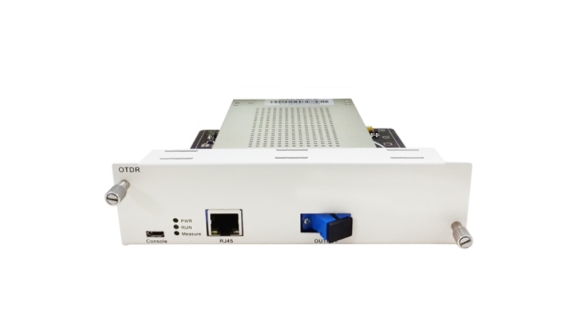

OTDR module 1625nm, dynamic range 40dB, SC / UPC, occupies 2 slots
OTDR 1625nm module, dynamic range 36dB, SC / UPC, occupies 2 slots
Let's consider a specific example of using a reflectometer. Below is a diagram of one of the really created systems of dense spectral compaction.

The OTDR reflectometer operates at a wavelength of 1625 nm. The measuring device is connected via a special EDFA port of the amplifier (the TFF separation filter is part of the EDFA amplifier card). The high quality of the TFF filter contributes to reliable filtering of the measurement signal from user services of the C-band.
It is possible to place the reflectometer both on the transmission side and on the receiving side. The second option is better suited for extended lines (over 150 km), since it minimizes the harmful effect of forced Raman scattering (SRS).
The essence of this phenomenon: a C-band signal with a wavelength of 1550 nm propagates along the fiber. The backscattering signal falls on the frequencies of the OTDR 1625/1650 nm reflectometer and passes through the TFF filter of the test OTDR port with almost no loss. Despite the fact that the power level of Raman scattering is quite small, it can significantly reduce the dynamic range of the reflectometer due to its high sensitivity.
The software of the OTDR-reflectometer card allows you to link the reflectogram to the route diagram of the fiber-optic cable laying and the parameters of the fiber-optic cable. Thus, an accurate determination of the location of damage to the optical fiber is achieved.
The measurement is performed in batches of pulses with averaging of the resulting reflectogram. Thus, noise components are minimized. By setting the frequency of pulse bursts, you can set the interval between measurements.
You can also set the value of the deviation of the current reflectogram from the original one for triggering an alarm for exceeding a given threshold, notifying the operator about the degradation/damage of the optical fiber.
Conclusion: the complete set of DWDM equipment with an optical reflectometer card provides great opportunities for monitoring and detecting malfunctions of optical fibers with their accurate localization.